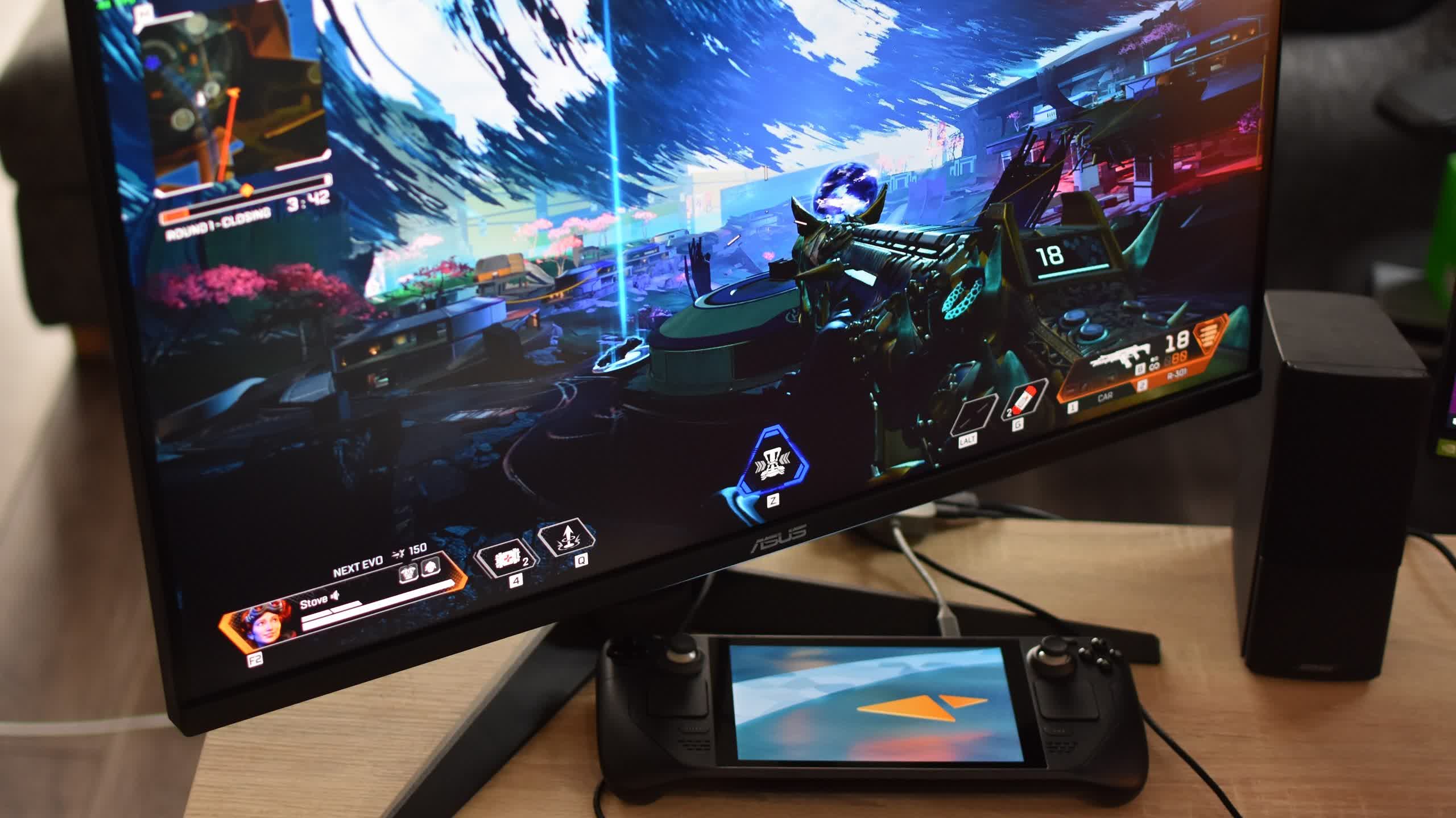
Linux Kernel
Kernel Patch Cuts Steam Deck Frame-Time Spikes by 32%
A per-core EPP boost mechanism proposed by Meta engineer David Vernet targets the worst-case frame pacing on AMD APU handhelds running Linux, with measured gains on Civilization VI's built-in benchmark.

Frame Pacing, Not Frame Rate, Is the Handheld Problem
Average frames per second has long been the headline number for PC gaming performance, but on handheld hardware running at constrained power budgets, the real quality-of-life metric is something else entirely: how consistent each frame's delivery time remains over a play session. A game with a healthy average frame rate can still feel choppy if every few seconds a frame takes twice as long as its neighbors. Those micro-stalls, known as frame-time spikes, are what players perceive as stutter, and they are particularly punishing on devices like the Steam Deck, where the display's refresh window is fixed and any missed deadline shows up as a visible hitch. The problem is compounded by the way most game engines schedule work: a single dominant thread issues draw calls and physics ticks, then sleeps briefly before waking again. Under the Linux kernel's default frequency-scaling behavior, that sleep-wake cadence can trick the CPU into dropping its clock speed at exactly the wrong moment, forcing the next frame to ramp back up from a low-power state. Closing that gap between what the hardware thinks is idle and what the game actually needs is the motivation behind a new set of patches from David Vernet, a Linux kernel engineer at Meta.
How the epp_boost Module Works
AMD's `amd-pstate` driver governs processor frequency on modern Ryzen and EPYC chips under Linux. One of its levers is the Energy Performance Preference attribute, a per-core value that tells the hardware whether the software currently running favors raw speed or battery conservation. In active EPP mode, the CPU itself decides the trade-off, which works well for general workloads but misreads the bursty pattern of game threads. Vernet's patches introduce an alternative mode called `epp_boost`. When enabled, the module samples each core every 10 ms. If a core registers at least 50% utilization in that window, the driver writes the "performance" EPP value into that core's control register, overriding whatever the hardware had chosen. The override persists until 300 ms elapse without another busy sample, at which point the driver restores the core's previous EPP setting. The logic is deliberately simple: it acts as a fast-acting guardrail that keeps a gaming thread's core pinned at high frequency during active bursts, then releases it cleanly when the workload subsides. No background service, no user-space daemon, no game-specific profiles — just a kernel-level heuristic applied uniformly across every core on the die.
Civ VI Benchmark: 31.8% Higher 1%-Lows
Vernet tested the patch set using Civilization VI's built-in benchmark on a Steam Deck running SteamOS. He chose Civ VI for two reasons: the game leans heavily on single-thread CPU performance, and its benchmark pass is deterministic enough to produce repeatable runs. The results showed no change in average frame rate, which was expected — the patch does not raise the ceiling. What it does is raise the floor. The 1%-low frame rate, representing the worst frames in a run, climbed by 31.8%. The p99 frame time, the 99th-percentile latency for a single frame, improved by 4.1%. Both figures point to the same underlying effect: the driver now holds frequency on the critical thread long enough to prevent the brief clock dips that produce visible stutter. Because the mechanism is agnostic to the specific game, Vernet expects it to generalize to other titles on any SteamOS or Linux handheld built around an AMD APU, though he has not published benchmarks for other games.
SteamOS and the Handheld Market
The patches target the `amd-pstate` driver, which is designed to improve control over processor frequency in AMD CPUs running Linux. The driver includes the Energy Performance Preference attribute, which tells the hardware whether the currently running software wants maximum speed or wants to save battery power. Vernet's patches build on the driver's active mode, which normally lets the AMD APU decide the best strategy for whatever's running. Gaming workloads, mostly built around one busy thread taking frequent short sleeps, tend to perform poorly under that kind of scheme. If the new code is merged into the mainline kernel and picked up by a future SteamOS update, the change would require no action from users or game developers — it would simply make existing titles run more consistently on the silicon already in players' hands.
Source material: techspot.com — this piece is based on that published source material.
Images