Base Building
Flow of War: deep economy, sidelined combat, and an AI that trips on its own initiative
Layout mistakes stem from the worker AI's initiative, the full release adds content without fixing core weaknesses, and the game's appeal rests on classic RTS fans who can tolerate constant micro-management.
How does Flow of War's economy actually work?
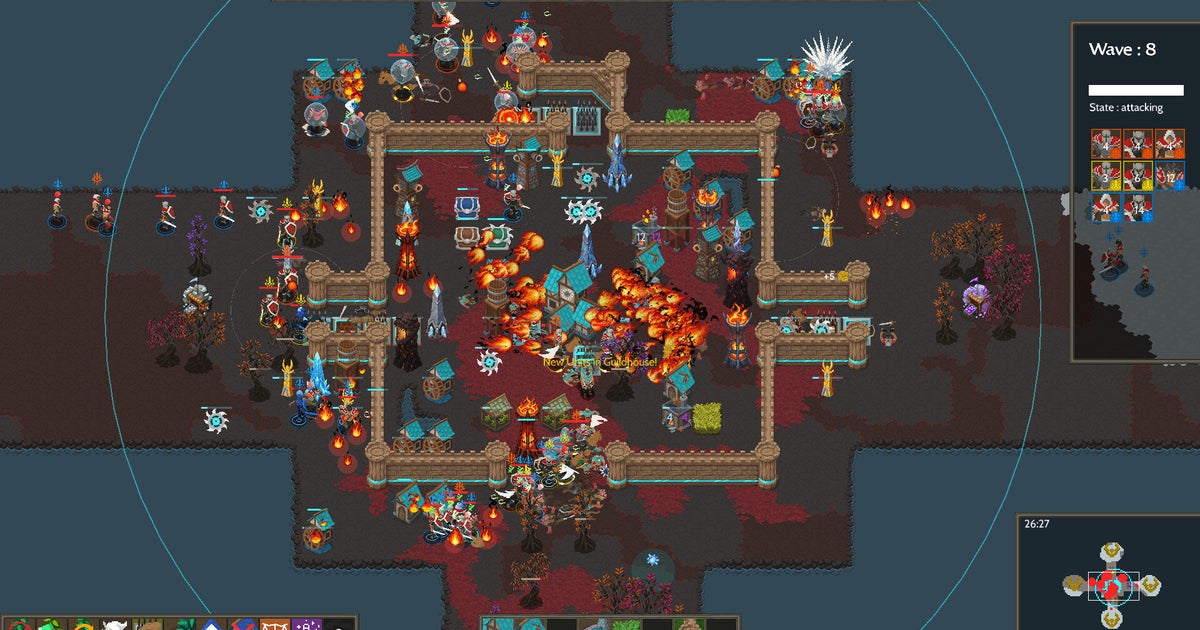
Flow of War's economy runs on a hands-off loop. You conjure minions from your town hall, then place down templates for cropfields, forges, wells, and similar structures. The workers—described as tireless and uncomplaining—automatically build and gather without further input. Your real job is laying out those templates efficiently, because the AI will not compensate for a bad design. The game presents no direct control over individual workers; instead, you shape the terrain chemistry and let the AI handle the rest. That includes watching the timer run down before a fresh wave of attackers emerges from hellportals around the map. The whole system is designed for indirect thinking, working with the AI's gradually discovered quirks rather than overruling it with relentless micromanagement. A poorly placed field or a convoluted wall layout directly affects how many resources you stockpile before combat begins.
What base layout mistakes cause the most worker downtime?
The demo's 30 minutes teach you quickly. Carving out a huge 8x2 block of fields forces workers to walk all the way around it to water and reap the crops on the far side—a simple geometry problem that wastes trips. Erecting an intricate maze of walls and arrow towers adds roughly 10 extra seconds for your toilers to navigate fortifications when they need to perform repairs, which compounds every time they do. Rapid expansion is the third trap: if you expand your base too quickly, workers may set out on construction tasks and encounter resource nodes or combat zones beyond your defensive line. The AI has a habit of seizing the initiative, so a worker building a water wheel might spot a goldmine and decide to pocket nuggets, carrying itself straight into the path of enemy swordsmen. That's how you accidentally wall a worker out and force it to take the long way back around a lake to your town hall.
How does combat work, and is it the game's focus?
Military units are recruited manually and steered with drag-select, the classic 90s RTS control. You can hire standard swords, multishot archers, and wizards—each with a distinct role. The active military aspect isn't especially deep; it feels supplementary to the more engaging defense and automated economy systems. Waves of attackers emerge from hellportals scattered around the map, and your army's job is to fend them off before they reach your layout. In practice, you'll use drag-select to group your murderfolk and send them toward the portal spawn points, but the real challenge lies in positioning your buildings to funnel the enemy into kill zones and keeping your workers efficient so they can repair and gather between assaults. The game expects you to balance army production against construction and research, all drawing on the same pool of resources. That means every sword you recruit or archer you train is a resource not spent on a new arrow tower or a research tier. Since the military aspect lacks depth, most players will spend their time on layout optimization rather than micro-managing skirmishes, and the manual steering feels more like a fallback than a core pillar.
What does the full game include beyond the demo?
The full release of Flow of War offers 30 maps to chew through, each replayable on higher difficulties. You also get a map editor for designing your own layouts and a randomiser for procedurally generated challenges. That's a substantial amount of content for the asking price of £10/$10/€10 or so. The demo alone can consume 30 minutes just to learn the basics, so the full campaign represents many hours of optimization. The map editor and randomiser extend the game's lifespan significantly, especially for players who enjoy testing layouts against different enemy compositions. There's no mention of multiplayer or online features, so this is a purely single-player package. The map editor lets you place the same fields, forges, wells, and walls from the campaign, then save your best defensive schemes for later use. The randomiser can shuffle the hellportals and resource placements, forcing you to adapt your layout every run. With 30 handcrafted maps plus the randomiser, you can easily double or triple the playtime, and higher difficulties boost enemy wave intensity without changing the core mechanics. For $10, the price-to-content ratio is strong, and the editor alone adds a creative layer that many RTS titles at this price lack.
What are Flow of War's main weaknesses?
The most obvious shortcoming is visual. Flow of War is no visual extravaganza, with a quite plain interface. That's not damning for the audience it targets—players who came of age on early Warcraft and Empire Earth titles will likely overlook the dated presentation. There are few other criticisms so far, but the military side lacks depth, and the worker AI's initiative can become a liability when expansion happens too quickly. What it isn't is a game you'll buy for graphics. For $10, the trade-off between depth and presentation is acceptable, especially given the map editor. The interface is functional but sparse: you'll spend most of your time staring at a top-down view of cropfields and forges, with units rendered as simple sprites. The plainness extends to the menus, which look straight out of the 90s—no fancy art, just utilitarian buttons. That said, the game's strengths lie in its systems, and the visual austerity lets you focus on the strategic geometry of your layout. The few criticisms that do exist are minor: the lackluster military could disappoint those expecting a full RTS button-mash, and the worker AI's occasional detours can be frustrating. But for the price, these are easy to forgive, and the map editor offers a creative outlet that compensates for the humble presentation.
How does the worker AI's 'initiative' create accidental problems?
The worker AI is designed to act without direct orders, which is generally a benefit. But it can also be a liability. Workers may opportunistically gather resources or take detours that expose them to threats, especially if they wander beyond your defensive perimeter. If your fortifications block their return path, they can be cut off entirely, wasting both their collected resources and construction time. This is a direct consequence of placing structures too close to the map edge or expanding without a secure perimeter. The lesson is to keep future build sites inside your defensive footprint, and to leave clear paths for returning workers. A concrete example from the demo: a worker set out to build a water wheel, spotted a goldmine on the way, pocketed some nuggets, and walked straight into a pack of sword-wielding enemies. Because you had placed a wall, the worker couldn't retreat and had to take the long way around a lake, delaying repairs and risking another encounter. This 'initiative' is a double-edged sword—it allows the economy to run itself, but it also means you must carefully choose where to expand and how to lay out your walls. Even a simple 8x2 block of fields can cause problems if workers have to walk all the way around it to water and reap the far side, wasting time that could be spent reinforcing defenses. So the practical takeaway is: before you plop down a new structure, think about the paths your workers will take and whether they'll stay inside your walls.
Who is Flow of War for, and what makes it appealing to classic RTS fans?
Flow of War is pitched squarely at players who remember 90s-style RTS games—think Warcraft II and Empire Earth. It has the same kind of pixelated visuals, overhead camera, and drag-select unit handling. What sets it apart is the automated economy that lets you focus on indirect strategy rather than micromanaged harvesting. The game offers a particular pleasure in shaping the terrain chemistry and working with the AI's quirks instead of fighting them. The game also rewards careful research timing and defensive layout, which fits a more methodical playstyle. With 30 maps and a randomiser, there's plenty of content for players who like optimizing under escalating pressure. At about $10, it's a low-cost entry for nostalgia-driven RTS veterans who prefer the 30-map, replayable format over a single lengthy campaign. Instead of clicking every peasant to a gold vein, you set up templates and let the AI handle the drudgery. The satisfaction comes from watching your serfs build a fortress while you tweak the placement of arrow towers and research tiers. The game demands patience and foresight, not twitch reflexes, and the 30 maps with higher-difficulty modifiers give veterans a reason to fine-tune their strategies. Even the map editor and randomiser cater to that experimental mindset, letting you test layouts without restarting the campaign. For anyone who loved the structural puzzle of classic RTS but hated the babysitting, Flow of War is a tidy, affordable fit.
Source material: rockpapershotgun.com — this piece is based on that published source material.
Images